
Blackjack strategy guide
How to Count Cards in Blackjack: A Practical Hi-Lo Guide
Card counting does not predict the next card and it never guarantees a win. It is a way to estimate whether the cards left in the shoe may be more favorable to the player or to the casino.
Before learning the mechanics, it helps to understand why card counting can work at all. In blackjack, the composition of the cards that remain affects the balance between the casino’s edge and the player’s expected value.
When many low cards have already left the shoe, the remaining cards contain a relatively higher concentration of tens, face cards and aces. That can be more favorable to the player. When many tens and aces have already appeared, relatively more small cards remain, which is usually less favorable.
These groups do not imply that there is a separate deck made only of low or high cards. They simply help us estimate how the composition of the remaining shoe changes as cards are dealt. Counting does not tell you exactly what comes next.
First requirement: know basic strategy
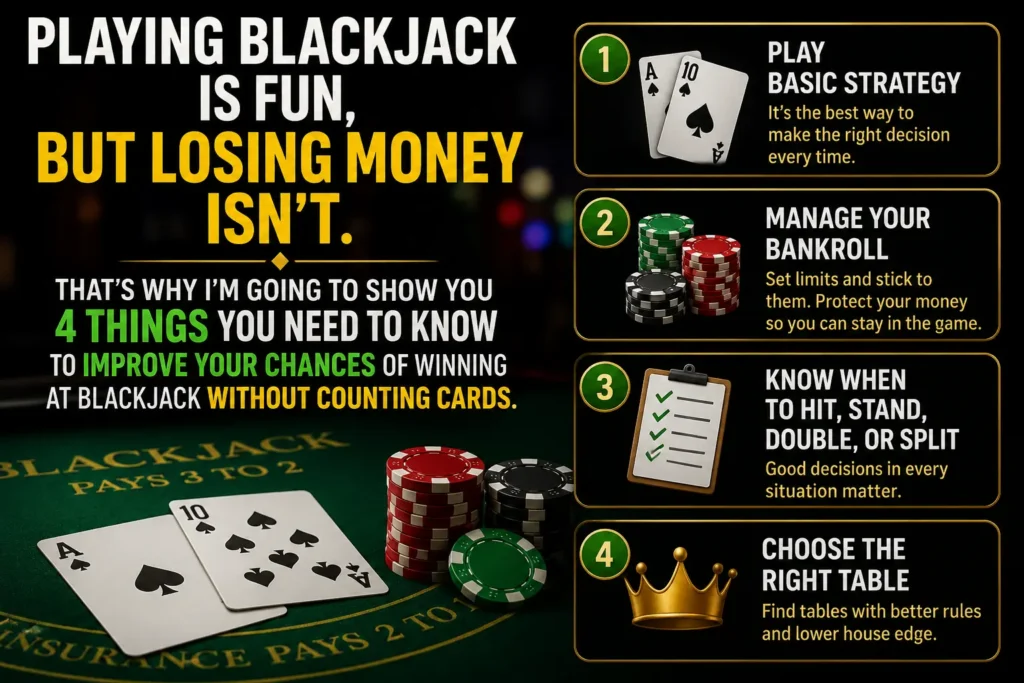
Before you learn to count, you need a strong command of blackjack basic strategy. If every hand requires a long decision about whether to hit, stand, double or split, it will be difficult to maintain an accurate count at the same time.
Basic strategy should become almost automatic. Only when you can play most situations correctly without prolonged thought does it make sense to add card counting.
The Hi-Lo system
The system explained here is called Hi-Lo, one of the best-known balanced card-counting systems. Every card receives one of three values:
Low cards: +1
Whenever you see a 2, 3, 4, 5 or 6, add one. If the cards are 3, 5 and 6, the change is +1 +1 +1 = +3.
Neutral cards: 0
Sevens, eights and nines do not change the count. If you are at +3 and a 7 and 9 appear, the count remains +3.
High cards: −1
Subtract one for every 10, jack, queen, king or ace. If you are at +3 and then see K, A, 10 and Q, the result is +3 −1 −1 −1 −1 = −1.
Running Count
The count does not restart with every hand. It continues through the entire shoe, from the shuffle until the next shuffle. This is the Running Count, often shortened to RC.
After the shuffle: RC = 0
First hand totals +3: RC = +3
Next hand totals −1: +3 −1 = +2
Following hand totals +2: +2 +2 = +4
You count every exposed card that leaves the shoe, not just your own cards. If you see 5, K, 8, 3, A, 6 and Q, their values are +1, −1, 0, +1, −1, +1 and −1. The total change is zero. If your RC was +6 before those cards, it is still +6 afterward.
Why the number of decks matters
In a single-deck game, the Running Count provides considerable information on its own. Modern blackjack, however, is commonly dealt from 2, 4, 6 or 8 decks. A +8 count with nearly a full eight-deck shoe remaining is not the same as +8 with only one deck left.
That is why a multi-deck player also estimates the number of decks remaining.
True Count
The True Count measures the Running Count in relation to the approximate number of decks left in the shoe.
Example 1: RC +20 ÷ 4 decks remaining = TC +5
Example 2: RC +12 ÷ 6 decks remaining = TC +2
Example 3: RC +12 ÷ 2 decks remaining = TC +6
The Running Count in the last two examples is identical, but the situation is not. Serious counting therefore requires you to update both the Running Count and your estimate of the cards still in play.
What a positive count actually means
A positive Hi-Lo count means relatively more low cards have already been dealt. Therefore, the remaining shoe has a relatively higher concentration of tens and aces.
This may help the player in several ways. A natural blackjack often pays more than an ordinary win when the table pays 3:2. More tens and aces can increase the chance of a natural, and the player can choose when to double while the dealer must follow fixed rules.
Expected value is not guaranteed profit
Suppose the player has a mathematical edge of 1% in a particular situation. That does not mean every $100 wagered produces a certain $1 profit. It means that across a very large number of comparable wagers, the mathematical average is expected to approach roughly +1% of the relevant betting volume.
Short-term results can be entirely different. You can have positive EV and lose the next hand, lose several hands in a row or finish the whole evening down. You can also win much more than the expectation. Blackjack has substantial variance, so short sessions can deviate sharply from the long-run average.
A precise statement is: a sufficiently positive True Count can, under suitable table rules, move the game from a small casino edge toward a small mathematical player edge.
Estimating the decks remaining
To calculate True Count, learn to estimate how many decks are left. If an eight-deck game appears half complete, about four decks remain. With RC +20, the estimate is 20 ÷ 4 = TC +5.
Now suppose RC is +18 with about 4.5 decks remaining. The TC is approximately +4. The next cards are 5, K, 7, A, 3, 10, 8 and 6. Their combined Hi-Lo value is zero, so RC stays +18. If half a deck has been played in the meantime and only four decks remain, the new True Count is 18 ÷ 4 = +4.5. The Running Count did not move, but the True Count increased.
Penetration
Penetration is the portion of the shoe dealt before the cut card is reached and the cards are shuffled again. In an eight-deck game, deeper penetration means more of those eight decks are played before the shuffle.
Penetration matters because an early shuffle leaves less time to use the information created by the count. Deeper play can make a count more meaningful because fewer cards remain. Check both the number of decks and how far the dealer goes into the shoe.
Not every blackjack table is the same
True Count is not the only factor that determines the player’s expected value. The exact table rules can change the mathematics significantly. Check:
- the number of decks;
- whether the dealer stands or hits on soft 17;
- whether double after split is allowed;
- which doubles are permitted;
- whether surrender is available;
- how many times a hand may be split;
- the blackjack payout;
- the penetration.
Pay particular attention to the payout: 3:2 blackjack and 6:5 blackjack are not equivalent games. This is why no universal rule such as “the player always has the edge at TC +2” can be accurate for every table.
Card counting and bet size
One reason players track the count is to change exposure as conditions change. In advantage play, exposure is lower when conditions are unfavorable and higher when the mathematics becomes more favorable.
That does not mean “the count is high, bet everything.” Bet size has to be connected to the bankroll, tolerance for risk and the estimated edge. Even with a mathematical advantage, a player can still lose many hands in a row.
Bankroll and variance
Counting does not remove risk. Even a highly skilled counter can experience long losing periods. A serious approach requires an understanding of:
- Bankroll: the total amount reserved for play.
- Betting unit: the base wager size.
- Bet spread: the relationship between the smallest and largest wagers.
- Expected Value (EV): the mathematical long-run expectation.
- Standard deviation / variance: how widely real results can differ from the average.
- Risk of Ruin: the probability of losing the bankroll before the long-run edge can be realized.
A more accurate claim than “card counting makes big money” is this: correct counting under suitable conditions can create positive expected value, but profit is not guaranteed and short-term variance can be severe.
Basic-strategy deviations
Advanced card counting goes beyond Basic Strategy, Running Count and True Count. Basic strategy is built for the standard starting composition of the cards. At sufficiently high or low True Counts, some decisions can change. These changes are called strategy deviations or index plays.
The count may affect a hit, stand, double or insurance decision in specific situations. Lists such as the Illustrious 18 collect well-known deviations, but they should come only after you can execute the foundations accurately.
Basic Strategy → Hi-Lo values → Running Count → Deck estimation → True Count → Betting strategy → Strategy deviations
A note on automatic shufflers
If a casino uses a Continuous Shuffling Machine (CSM) that continually returns used cards to play and reshuffles them, traditional counting is practically neutralized because the composition keeps resetting. This is different from an automatic machine that shuffles a complete shoe only after the previous shoe ends. Identify which system the table uses before you play.
Is card counting illegal?
Mental card counting—tracking exposed cards with your own mind—should not automatically be equated with cheating. However, laws and rules differ by country, state and jurisdiction. A casino may also stop the game or decline further blackjack play if it believes someone is an advantage player.
Electronic devices or other tools used to track cards or calculate probabilities are a different matter and may be prohibited by law. It is therefore inaccurate to say either “card counting is illegal everywhere” or “it is always permitted and the casino cannot respond.” Check local law and the casino’s rules.
The card-counting essentials
- Counting does not predict the next card.
- Hi-Lo values are 2–6 = +1, 7–9 = 0 and 10–A = −1.
- Running Count continues through the shoe and resets only after a shuffle.
- In multi-deck games, True Count equals Running Count divided by estimated decks remaining.
- A high positive True Count may improve expected value, but it cannot guarantee a winning hand or session.
Card counting becomes a complete system only when it combines basic strategy, accurate Running Count, deck estimation, True Count, table rules, penetration, disciplined bet sizing, bankroll management and strategy deviations. Until then, it is merely the arithmetic of +1 and −1.
Responsible gambling: this guide is educational and does not promise profit. Set a strict loss limit, never chase losses and do not gamble with money needed for essential expenses. If gambling stops being enjoyable or becomes difficult to control, stop and seek support through our responsible gambling resources.